
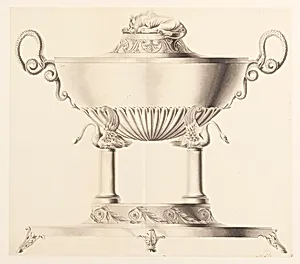
Design for a Tureen
Medium
Drawing
Classification
Drawing
Department
Smithsonian Collection
Museum
Smithsonian American Art Museum
Credit
Purchased for the Museum by the Advisory Council
Accession Number
1911-28-374
Rights
Public Domain
About this artwork
Research in Progress
Art Historical Context
In the early 19th century, Anton Seethaler II a German artist active from 1799 to 1868, created delicate *Design for a Tureen* around 1825–1835. Rendered as a drawing, exemplifies the meticulous preparatory sketches used by designers of the era to plan luxurious tableware. tureen, a deep serving vessel for soups orews, was a centerpiece of affluent dining, often crafted in silver, porcelain, or other fine materials, blending utility with opulent decoration. This work reflects the Biedermeier period's emphasis on refined neoclassicism in German decorative arts, where clean lines and balanced forms evoked classical antiquity amid post-Napoleonic stability. Seethaler's drawing likely served as a blueprint for silversmiths or potters, highlighting the collaborative process between artists and artisans that drove Europe's luxury goods trade. Its presence in the Smithsonian American Art Museum's collection, purchased by the Advisory Council, underscores transatlantic exchanges in design influences during a time when European styles shaped emerging American tastes. Though research continues, this piece invites us to appreciate the artistry behind everyday elegance, revealing how a simple sketch could inspire enduring objects of beauty and function.