
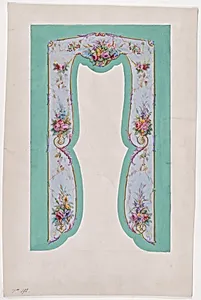
Design for a Valance with Floral Motifs
1870–1900 (?)
Medium
Watercolor
Dimensions
Sheet: 17 3/16 × 11 1/8 in. (43.6 × 28.2 cm)
Classification
Drawings|Ornament & Architecture
Department
Drawings and Prints
Museum
Metropolitan Museum of Art, New York, NY
Credit
Elisha Whittelsey Fund, 1949
Accession Number
49.50.193
Rights
Public Domain
Art Historical Context
This delicate watercolor design, created by an anonymous French artist 1870–1900, captures the elegance of late 19th-century decorative arts. Titled *Design for a Valance Floral Motifs*, it as a blueprint for a valance—a decorative fabric border often draped over beds or windows to add opulence to bourgeois interiors. The floral patterns, rendered with vibrant yet precise watercolor strokes, reflect the period's fascination with nature-inspired ornamentation, bridging historicism and the emerging Art Nouveau style. Watercolor was an ideal medium for such designs, allowing artists to convey texture, color, and light on fabric with luminous transparency and fine detail. Produced during France's Belle Époque, when textile manufacturing flourished amid industrial growth, this sheet exemplifies the collaborative world of designers, weavers, and manufacturers. Housed in the Metropolitan Museum of Art's Drawings and Prints department (acquired via the Elisha Whittelsey Fund in 1949), it offers a glimpse into the unseen craftsmanship behind everyday luxury. Though anonymous, the work highlights the era's emphasis on harmonious, flowing motifs that brought beauty to the home, underscoring how ornament elevated daily life in a rapidly modernizing society.
About the Artist
Anonymous, French, 19th century · 1800–1900
**Anonymous, French, 19th Century (ca. 1800–1900)** The artist cataloged as Anonymous, French, 19th century embodies the enigmatic yet essential contributions of unidentified creators to France's vibrant 19th-century art world. Active roughly between 1800 and 1900, this figure—or potentially collective workshop—produced a diverse array of works amid the nation's transition from Neoclassicism thro...