
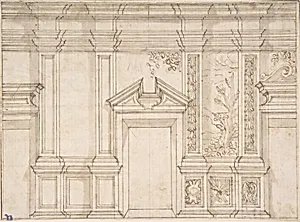
Design for a Wall Elevation with Garlands and a Landcape Scene
17th century
Medium
Pen and brown ink, brush and brown wash, over ruled graphite construction
Dimensions
sheet: 6 5/8 x 9 in. (16.8 x 22.8 cm)
Classification
Drawings|Ornament & Architecture
Department
Drawings and Prints
Museum
Metropolitan Museum of Art, New York, NY
Credit
The Elisha Whittelsey Collection, The Elisha Whittelsey Fund, 1952
Accession Number
52.570.14
Rights
Public Domain
Art Historical Context
This delicate 17th-century drawing an anonymous Italian artist captures the exuberant spirit of Baroque ornamentation, a hallmark of Italy's artistic flowering during that era. Titled *Design for a Wall Elevation Garlands and a Landscape*, it sketches a grand architectural panel for an interior wall, festooned with flowing garlands—likely symbolizing abundance and classical antiquity—and framed by a pastoral landscape. Such designs were preparatory studies for opulent palaces or churches, where frescoes, stucco, and illusionistic painting blurred the lines between architecture and art, immersing viewers in theatrical splendor. Crafted with precision on a modest sheet (6 5/8 x 9 in.), the work employs ruled graphite lines for structural accuracy, overlaid with fluid pen and brown ink for contours, and subtle brown wash for depth and shadow. This mixed-media technique, common among Italian draftsmen of the period, allowed architects and decorators to visualize complex elevations efficiently, bridging the gap from sketch to sculpted reality. Housed in the Metropolitan Museum of Art's Elisha Whittelsey Collection, it exemplifies the anonymous mastery behind Italy's lavish decorative arts, reminding us how everyday artisans shaped the grandeur of the Baroque age.