
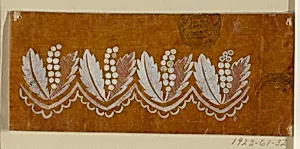
Design for a Woven or Embroidered Horizontal Border, of the "Fabrique de St. Ruf"
1805-1815
Medium
Drawing
Classification
Drawing
Department
Smithsonian Collection
Museum
Smithsonian American Art Museum
Credit
Smithsonian American Art Museum
Accession Number
1923-61-32
Rights
Public Domain
About this artwork
Research in Progress
Art Historical Context
This delicate drawing, titled *Design for a Woven or Emidered Horizontal Border* from the Fabrique de Ruf in Lyon, France (ca. 1805–1815), offers a glimpse into the golden age of French textile design. Created during the Napoleonic era, it served as a pattern for luxurious silk borders, likely intended for garments, furnishings, or trimmings. Lyon's silk industry, powered by innovative Jacquard looms introduced around 1801, made the city Europe's textile capital, exporting opulent fabrics worldwide, including to America. As a preparatory drawing, this work highlights the meticulous craft of 19th-century designers at Saint Ruf, a renowned manufactory. Such sketches translated intricate motifs—often floral, neoclassical, or geometric—onto woven or embroidered surfaces, blending artistry with industrial precision. The horizontal border format suggests use in shawls, ribbons, or upholstery, reflecting Empire-style elegance with its emphasis on symmetry and refinement. Housed in the Smithsonian American Art Museum's collection, this piece underscores the transatlantic exchange of luxury goods, bridging French innovation and American tastes. Though research continues, it beautifully captures how drawings fueled an industry that defined fashion and décor for a burgeoning elite.