
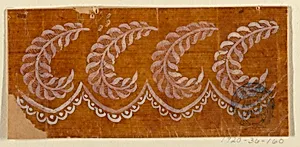
Design for an Embroidered or Woven Horizontal Border of the "Fabrique de St. Ruf"
1805–1815
Medium
Drawing
Classification
Drawing
Department
Smithsonian Collection
Museum
Smithsonian American Art Museum
Credit
Gift of Eleanor and Sarah Hewitt
Accession Number
1920-36-160
Rights
Public Domain
About this artwork
Research in Progress
Art Historical Context
This delicate drawing, created by the Fabrique de Ruf in Lyon, France, around 1805–1815, served as a design template for embroidered or woven horizontal borders in textiles. Lyon was Europe's premier center for silk production during the Napoleonic era, and factories like Saint Ruf specialized in luxurious fabrics that adorned garments, furnishings, and exports worldwide. Produced amid the Empire style's neoclassical revival, such patterns likely featured motifs inspired by ancient Greece and Rome—think garlands, urns, or anthemions—reflecting the period's grandeur and imperial ambition. As a preparatory drawing, this work highlights the meticulous artistry behind textile manufacturing. Designers sketched intricate repeats on paper, which weavers then translated onto looms or embroidery frames, often using emerging Jacquard technology for complex patterns. Its preservation in the Smithsonian American Art Museum, thanks to a gift from collectors Eleanor and Sarah Hewitt, underscores the transatlantic influence of French textiles on American decorative arts. Though research continues, this piece offers a window into early 19th-century craft innovation, where technical precision met aesthetic elegance, bridging fine art and everyday luxury.