
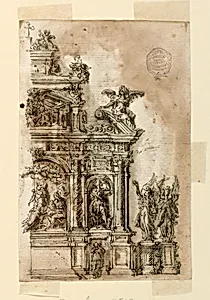
Design for an Altar
Medium
architecture, interiors
Classification
architecture, interiors
Department
Smithsonian Collection
Museum
Smithsonian American Art Museum
Credit
Museum purchase through gift of various donors
Accession Number
1901-39-1466
Rights
Public Domain
About this artwork
Research in Progress
Art Historical Context
**Design for an Altar** by Leonardo Scaglia invites us into the intricate world of 17th ecclesiastical architecture. A French artist active in Italy the 1640s and 1650s, Scaglia this design around 1640–50, the era's passion for opulent church interiors. Classified as architecture and interiors, likely served as a preparatory drawing or plan for a sacred altar space, essential for visualizing grandeur before construction. In the Baroque period, altar designs like this were pivotal, blending artistry with religious fervor amid the Counter-Reformation. Italian churches demanded dramatic, immersive spaces to inspire awe, and Scaglia's French background may have infused northern precision into Italy's exuberant style. Such works highlight how architectural drawings bridged imagination and reality, guiding sculptors, painters, and builders. Acquired by the Smithsonian American Art Museum through generous donor gifts, this piece reflects ongoing research into lesser-known talents like Scaglia. It reminds us how designs shaped Europe's spiritual landscapes, offering a window into a time when altars were both artistic triumphs and acts of devotion. (198 words)