
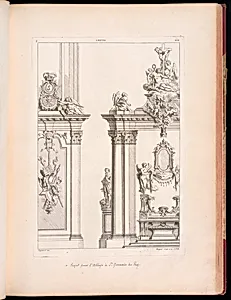
Design for an Altar
Medium
Bound print
Classification
Bound print
Department
Smithsonian Collection
Museum
Smithsonian American Art Museum
Credit
Purchased for the Museum by the Advisory Council
Accession Number
1921-6-216-45
Rights
Public Domain
About this artwork
Research in Progress
Art Historical Context
Gilles-Marie Oppenord (2–1742), a prominent French architect and designer of the Régence period, this *Design for an* as part of his oeuvre in ornamental arts. dated 1749–1761—likely reflecting posthumous publication or compilation—the work captures Oppenord's signature rococo flair, characterized by curves, intricate motifs, and a sense of asymmetry. As a master of decorative design, Oppenord served under Louis XIV and contributed to the Opéra at Versailles, blending Baroque grandeur with lighter, more whimsical forms that defined early 18th-century French taste. Rendered as a bound print, this medium was ideal for disseminating architectural ideas among artisans, architects, and patrons during the Enlightenment era. Bound volumes like this allowed for detailed study and replication, making elite designs accessible for church commissions or grand interiors. Altars, central to Catholic worship, often featured such elaborate plans to inspire awe and devotion through opulent decoration. Acquired by the Smithsonian American Art Museum through its Advisory Council, this piece highlights the transatlantic exchange of European design traditions. With ongoing research, it invites visitors to appreciate how Oppenord's vision bridged architecture and printmaking, influencing neoclassical revivals and sacred spaces worldwide.