
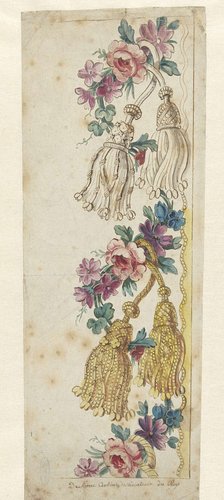
Design for an Embroidered Border
c. 1765 - 1775
Medium
pen
Dimensions
116; 329
Rights
Public Domain
About this artwork
height 329 mm x width 116 mm
Art Historical Context
**Design for an Embroidered Border** by Charles Germain de Saint-Aubin (1721–1786) is a delicate pen drawing from around 1765–1775, a slender 329 mm high by 116 mm wide. Created during the lavish Rococo era in France, this work exemplifies Saint-Aubin's expertise as an engraver, illustrator, and designer renowned for his intricate fashion plates and textile patterns. As one of the celebrated Saint-Aubin brothers, he contributed to the opulent visual culture of Louis XV's court, where such designs bridged art and everyday luxury. Pen and ink was the ideal medium for precise embroidery patterns like this, allowing artists to outline motifs with fine lines that needleworkers could faithfully reproduce. These borders adorned garments, furnishings, and accessories, reflecting the era's obsession with ornamentation—think floral scrolls, ribbons, and shells in the playful asymmetry of Rococo style. By the 1770s, as tastes shifted toward Neoclassicism, Saint-Aubin's work captured this elegant transition. This piece highlights the collaborative artistry of 18th-century design, where drawings like this fueled France's booming textile industry and influenced global fashion. Visitors, imagine stitching this border onto a silk gown— a testament to the craftsmanship that defined aristocratic life.