
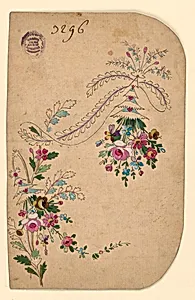
Design for an Emrboidery Repeat
1780–1800
Classification
Drawing
Department
Smithsonian Collection
Museum
Smithsonian American Art Museum
Credit
Gift of Eleanor and Sarah Hewitt
Accession Number
1914-21-60
Rights
Public Domain
About this artwork
Research in Progress
Art Historical Context
### Design for an Embroidery Repeat This delicate drawing, created between 1780 and 1800, served as a blueprint for an embroidery repeat—a repeating pattern essential for producing textiles like curtains, upholstery, or clothing. Housed in the Smithsonian American Art Museum's collection (gift of Eleanor and Sarah Hewitt), it exemplifies the preparatory sketches that bridged artistic creativity and practical craftsmanship in early American decorative arts. Though the artist remains unknown and research is ongoing, such designs were vital tools for needleworkers, allowing motifs to tile seamlessly across fabrics. In the late 18th and early 19th centuries, embroidery flourished in American households and workshops, reflecting influences from European styles amid growing national identity. These repeats democratized complex patterns, enabling home sewers and professional embroiderers to create harmonious, large-scale works without starting from scratch. As a drawing (medium details pending further study), it highlights the precision of graphite or ink techniques used to outline motifs—likely floral, geometric, or neoclassical—before translation into thread. This piece invites us to appreciate the unsung labor behind everyday beauty, underscoring embroidery's role in cultural expression and domestic economy during America's formative years. A testament to anonymous ingenuity, it awaits deeper scholarly insights. (198 words)
About the Artist
Unknown
The artist designated as "Unknown" in our virtual museum's collection exemplifies a poignant chapter in art history: creators whose identities have faded into obscurity despite the enduring power of their work. With only one known artwork attributed to them in our holdings, this figure represents countless anonymous hands that shaped visual culture across centuries. Museums worldwide, including th...