
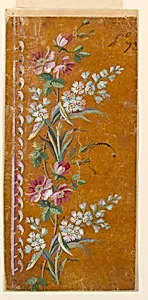
Design for an Embroidered Border of the "Fabrique de St. Ruf"
1800–1825
Classification
Drawing
Department
Smithsonian Collection
Museum
Smithsonian American Art Museum
Credit
Gift of Eleanor and Sarah Hewitt
Accession Number
1920-36-50
Rights
Public Domain
About this artwork
Research in Progress
Art Historical Context
This delicate drawing, titled *Design for an Embro Border of the "Fab de St. Ruf"*, hails from the renowned textile hub of Lyon, France, created between 1800 and 1825 by the Fabrique Saint Ruf workshop. Lyon was Europe's silk capital during this era, producing luxurious fabrics for fashion, furnishings, and export amid the Napoleonic Empire and early Restoration periods. As a design pattern for embroidery—likely intended for borders on garments, shawls, or upholstery—it exemplifies the meticulous planning behind France's high-end textile industry, where intricate motifs were translated from paper to thread for global markets. Though the medium remains unidentified, its classification as a drawing underscores the pivotal role of preparatory sketches in 19th-century manufacturing. These works bridged artistry and industry, allowing designers to refine floral, geometric, or neoclassical patterns before costly production. The Fabrique de Saint Ruf contributed to Lyon's legacy of innovation, blending handcraft with emerging mechanization. Generously gifted to the Smithsonian American Art Museum by collectors Eleanor and Sarah Hewitt, this piece invites us to appreciate the unsung craft behind opulent textiles. Ongoing research promises deeper insights into its motifs and techniques, highlighting how such designs shaped everyday elegance in the early 1800s. (198 words)