
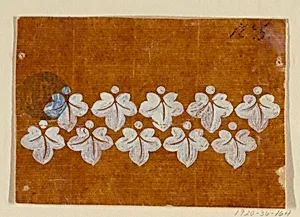
Design for an Embroidered or Woven Horizontal Border of the "Fabrique de St. Ruf"
1805–1815
Medium
Drawing
Classification
Drawing
Department
Smithsonian Collection
Museum
Smithsonian American Art Museum
Credit
Gift of Eleanor and Sarah Hewitt
Accession Number
1920-36-164
Rights
Public Domain
About this artwork
Research in Progress
Art Historical Context
This delicate drawing, titled *Design for an Embro or Woven Horizontal Border the "Fabrique de. Ruf"*, hails from the renowned textile manufactory Fabrique de Ruf in Lyon, France, dating to 1805–1815. Lyon, long celebrated as Europe's silk-weaving capital, was a of innovation during the Napoleonic era, producing exquisite fabrics for fashion, furnishings, and export. This preparatory sketch served as a blueprint for intricate borders, likely intended for luxurious textiles like shawls, curtains, or garments, capturing the era's elegant Neoclassical motifs. As a simple yet precise drawing, it exemplifies the essential role of design drafts in textile production. Artisans would translate such patterns onto Jacquard looms or embroidery frames, enabling complex woven or stitched repeats. Created amid France's post-Revolutionary resurgence in luxury goods, it reflects the "Fabrique de St. Ruf's" contribution to high-end decorative arts, blending technical precision with ornamental flair. Now part of the Smithsonian American Art Museum's collection—generously gifted by Eleanor and Sarah Hewitt—this piece invites us to appreciate the unsung artistry behind everyday opulence. Though research continues, it stands as a window into Lyon's golden age of silk design.