
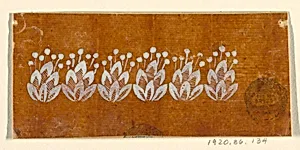
Design for an Embroidered or Woven Horizontal Border of the "Fabrique de St. Ruf"
1805–1815
Classification
Drawing
Department
Smithsonian Collection
Museum
Smithsonian American Art Museum
Credit
Gift of Eleanor and Sarah Hewitt
Accession Number
1920-36-134
Rights
Public Domain
About this artwork
Research in Progress
Art Historical Context
This delicate drawing, titled *Design for an Embroidered or Woven Horizontal Border the "Fabrique de. Ruf"*, hails from the renowned silkactory Fabrique de Saint in Lyon, France, to 1805–1815. Lyon was Europe's silk weaving capital during this era, producing luxurious textiles for fashion, furnishings, and export amid the Napoleonic Empire's opulent tastes. As a preparatory sketch classified as a drawing, it as a blueprint for artisans to execute intricate embroidered or woven patterns, highlighting the collaborative craft of textile design where precision met creativity. The piece reflects the Neoclassical influences of early 19th-century France, with borders often featuring repeating motifs suited for garments, shawls, or upholstery. Fabrique de Saint Ruf exemplified Lyon's innovative workshops, blending traditional Jacquard loom techniques with emerging industrial methods. Now in the Smithsonian American Art Museum's collection—gifted by design pioneers Eleanor and Sarah Hewitt—this artifact underscores transatlantic exchanges in decorative arts, bridging French elegance with American appreciation for craft heritage. Though research continues, such designs offer a window into the labor-intensive world of silk production, where a single pattern could inspire thousands of yards of fabric, adorning elites across continents.