
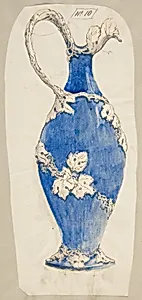
Design for an Ewer
19th century
Medium
Pen and black ink, brush and gray and blue wash, over graphite. Design pasted to gray mounting paper.
Dimensions
sheet: 14 5/16 x 9 5/8 in. (36.3 x 24.5 cm)
Classification
Drawings
Department
Drawings and Prints
Museum
Metropolitan Museum of Art, New York, NY
Credit
Rogers Fund, 1966
Accession Number
66.631.33
Rights
Public Domain
Tags
Art Historical Context
This delicate *Design for an Ewer*, created by an anonymous French artist in the 19th century, offers a glimpse into the elegant world of ornamental metalwork design. Ewers—pitchers often used for pouring water in affluent households or ceremonial settings—were prized for their decorative flair during this era of opulent French craftsmanship. The sheet, measuring 14 5/16 x 9 5/8 inches, features intricate motifs of leaves, evoking natural abundance and the period's fascination with organic forms inspired by nature and classical motifs. Executed in pen and black ink with brush and gray and blue washes over graphite, then pasted onto gray mounting paper, the drawing showcases meticulous preparatory techniques typical of 19th-century ateliers. Graphite underdrawing allowed for precise planning, while ink and washes added depth, texture, and subtle color to simulate the sheen of polished silver or gilt bronze. Such designs were likely intended for silversmiths or porcelain makers, bridging fine art and functional objects in France's thriving decorative arts scene. Acquired through the Rogers Fund in 1966 and housed in the Metropolitan Museum of Art's Drawings and Prints department, this anonymous work highlights the collaborative, unsung labor behind luxurious 19th-century furnishings, reminding us how sketches like this brought beauty into everyday life.
About the Artist
Anonymous, French, 19th century · 1800–1900
**Anonymous, French, 19th Century (ca. 1800–1900)** The artist cataloged as Anonymous, French, 19th century embodies the enigmatic yet essential contributions of unidentified creators to France's vibrant 19th-century art world. Active roughly between 1800 and 1900, this figure—or potentially collective workshop—produced a diverse array of works amid the nation's transition from Neoclassicism thro...