
Design for an Incense Burner (?)
19th century
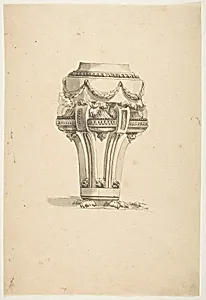
Medium
Pen and ink with wash on laid paper
Dimensions
sheet: 11 13/16 x 7 7/8 in. (30 x 20 cm)
Classification
Drawings
Department
Drawings and Prints
Museum
Metropolitan Museum of Art, New York, NY
Credit
The Elisha Whittelsey Collection, The Elisha Whittelsey Fund, 1955
Accession Number
55.540.10
Rights
Public Domain
Tags
Art Historical Context
This delicate 19th-century French drawing, tentatively titled *Design for an Incense Burner captures the imagination as a preparatory sketch for an elegant decorative object. Created anonymously by a skilled draftsman, it exemplifies the meticulous design process behind luxury household items during France's Belle Époque era, when ornate metalwork and ceramics flourished in bourgeois homes and ecclesiastical settings. Incense burners, evoking ritualistic scents and opulent style, were popular symbols of refinement, blending functionality with artistic flair. Executed in pen and ink with wash on laid paper—a traditional support with visible chain lines that lent texture and durability—the artist employed precise linework for contours and subtle gray washes to model form and shadow. This technique allowed for quick yet evocative rendering, ideal for workshop presentations to clients or craftsmen. Measuring just 11 13/16 x 7 7/8 inches, its intimate scale invites close viewing, revealing the draftsman's command of light and volume. Housed in the Metropolitan Museum of Art's Drawings and Prints department as part of The Elisha Whittelsey Collection (acquired 1955), this work highlights the unsung role of anonymous designers in shaping 19th-century decorative arts. It offers a window into the creative prelude to finished masterpieces, reminding us how sketches like this bridged imagination and reality.
About the Artist
Anonymous, French, 19th century · 1800–1900
**Anonymous, French, 19th Century (ca. 1800–1900)** The artist cataloged as Anonymous, French, 19th century embodies the enigmatic yet essential contributions of unidentified creators to France's vibrant 19th-century art world. Active roughly between 1800 and 1900, this figure—or potentially collective workshop—produced a diverse array of works amid the nation's transition from Neoclassicism thro...