
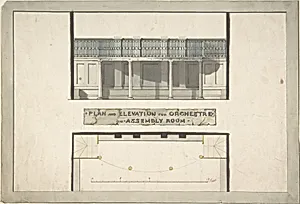
Design for an Orchestra Gallery in an Assembly Room, Plan and Elevation
Medium
Pen and ink and watercolor
Dimensions
sheet: 8 3/4 x 12 1/4 in. (22.2 x 31.1 cm)
Classification
Drawings|Ornament & Architecture
Department
Drawings and Prints
Museum
Metropolitan Museum of Art, New York, NY
Credit
The Elisha Whittelsey Collection, The Elisha Whittelsey Fund, 1960
Accession Number
60.632.8
Rights
Public Domain
Tags
Art Historical Context
This delicate architectural drawing, created around 1800 by an anonymous British artist, presents both the plan and elevation of an orchestra gallery designed for an assembly room. Rendered in pen and ink with watercolor, the sheet captures the functional yet decorative requirements of late Georgian and early Regency-era public spaces. The compact dimensions highlight its role as a working design document, likely intended for builders or patrons to visualize how musicians would be positioned above the dance floor or audience. Assembly rooms were central to British social life during this period, hosting concerts, balls, and gatherings in cities like Bath and London. Such galleries allowed orchestras to perform without obstructing the main floor while adding architectural elegance through railings, columns, and ornamental details. The use of watercolor not only clarifies the spatial layout but also suggests the intended color scheme and lighting effects, reflecting the era’s emphasis on harmonious interiors. As part of the Metropolitan Museum’s collection of ornament and architecture, this work offers a glimpse into the collaborative process between designers and craftsmen. It reminds visitors how even utilitarian spaces were shaped by neoclassical taste and the growing demand for refined public entertainment.