
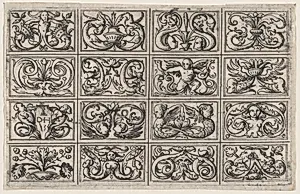
Design for Armor Decoration
ca. 1515
Medium
Etching; second state of two
Dimensions
Sheet: 3 3/8 × 5 5/16 in. (8.5 × 13.5 cm)
Classification
Prints
Department
Drawings and Prints
Museum
Metropolitan Museum of Art, New York, NY
Credit
Rogers Fund, 1918
Accession Number
18.55.1
Rights
Public Domain
Tags
Art Historical Context
Daniel Hopfer's *Design for Armor Decoration*ca. 1515) is a captivating example of early Renaissance printmaking from Germany. As an Augsburg goldsmith and arm, Hopfer pioneered etching—a revolutionary technique he adapted from his metalworking trade. This small etching (3 3/8 × 5 5/16 in.), in its second state of two, features intricate ornamental motifs suited for embellishing knightly armor, blending Gothic flourishes with emerging Renaissance elegance. Etching allowed Hopfer to incise designs into iron plates with acid, producing fine, detailed lines unattainable by traditional engraving. This innovation democratized elaborate decoration, influencing armorers and later printmakers like Albrecht Dürer. Acquired through the Rogers Fund in 1918, the work exemplifies the Met's Drawings and Prints collection, highlighting how prints served practical design purposes in the early 16th century. In an era of chivalric pageantry and Italianate grotesques infiltrating Northern Europe, Hopfer's pattern evokes the opulence of tournament armor—fantastical scrolls and strapwork that transformed functional protection into wearable art. A testament to craftsmanship bridging art and utility, it invites us to appreciate the artistry behind the clang of battle.
About the Artist
Daniel Hopfer · 1471–1536
Daniel Hopfer (c. 1470–1536), born in Kaufbeuren, was the son of the painter Bartholomäus Hopfer and Anna Sendlerin. He relocated early to Augsburg, becoming a citizen and master painter there in 1493, and trained as an etcher of armor in this thriving center of arms production. By 1505, he owned a house in the city center and served on the guild committee for smiths, which encompassed painters an...