
Design for Brougham/D'Orsay
ca. 1870
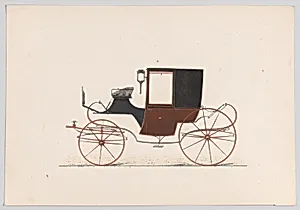
Medium
Hand colored lithograph with gum arabic
Dimensions
sheet: 6 3/16 x 8 15/16 in. (15.7 x 22.7 cm)
Classification
Prints
Department
Drawings and Prints
Museum
Metropolitan Museum of Art, New York, NY
Credit
Gift of William Brewster, 1923
Accession Number
23.112.1373
Rights
Public Domain
Tags
Art Historical Context
Step into the elegant world of 19th French transportation with this anonymous hand-colored lithograph, *Design for Brougham'Orsay*, created around 1870. The Brougham, named after British Lord Chancellor Henry Brougham, was a sleek, closed carriage favored by the elite for its compact luxury and single-horse pull, while the D'Orsay variant evoked the stylish flair of Parisian fashion. This print captures a proposed design at the twilight of the horse-drawn era, just before automobiles began reshaping urban life in post-Napoleonic France. Crafted as a lithograph—a revolutionary 19th-century printing technique allowing precise reproductions from stone plates—the image gains vivid life through meticulous hand-coloring and gum arabic, a natural resin that adds glossy depth and preserves hues. Measuring a modest 6 3/16 x 8 15/16 inches, it served likely as a trade catalog illustration for carriage makers, blending technical draftsmanship with artistic allure. Housed in the Metropolitan Museum of Art's Drawings and Prints department (gift of William Brewster, 1923), this piece offers a window into the cultural obsession with refined mobility, where vehicles were rolling statements of status and ingenuity. A delightful glimpse of vanished glamour!
About the Artist
Anonymous, French, 19th century · 1800–1900
**Anonymous, French, 19th Century (ca. 1800–1900)** The artist cataloged as Anonymous, French, 19th century embodies the enigmatic yet essential contributions of unidentified creators to France's vibrant 19th-century art world. Active roughly between 1800 and 1900, this figure—or potentially collective workshop—produced a diverse array of works amid the nation's transition from Neoclassicism thro...