
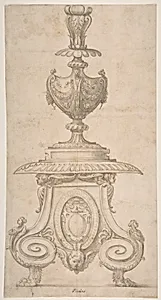
Design for Candlestick or for a Crucifix Base
Medium
Pen and brown ink, brush and brown wash, over leadpoint
Dimensions
14 15/16 x 7 13/16 in. (37.9 x 19.8 cm)
Classification
Drawings|Ornament & Architecture
Department
Drawings and Prints
Museum
Metropolitan Museum of Art, New York, NY
Credit
The Elisha Whittelsey Collection, The Elisha Whittelsey Fund, 1955
Accession Number
55.660.3
Rights
Public Domain
Tags
Art Historical Context
This exquisite drawing, titled *Design for Candlestick or for a Crucifix Base*, to around 1540–47 and showcases the collaborative talents of Luzio Luzzi (also known Luzio Romano or Luz da Todi), a sculptor and architect, andino del Vaga (Pietro Buonaccorsi), leading Mannerist painter from Raphael's circle. Housed in the Metropolitan Museum of Art's Drawings and Prints department, this large sheet (nearly 15 x 8 inches) exemplifies the ornate architectural fantasies of mid-16th-century Rome, where such designs served as blueprints for lavish liturgical furnishings in churches. Executed in pen and brown ink with brush and brown wash over leadpoint underdrawing, the work reveals a meticulous process: faint leadpoint sketches provide the foundation, refined by precise ink lines and tonal washes that model sculptural forms. Mannerist flourishes abound in the intricate cartouches—scroll-like frames often filled with playful motifs—and fantastical heads, evoking the grotesque and strapwork popular in Roman workshops. This dual-purpose design, adaptable for a candlestick or crucifix base, highlights the versatility of Renaissance draftsmen in blending utility with exuberant decoration. As part of The Elisha Whittelsey Collection, it offers a window into the bustling creative milieu of papal Rome, where artists like Luzio and Perino fused sculpture, architecture, and illusionistic ornament to elevate sacred spaces. A testament to workshop ingenuity, it invites visitors to appreciate the preparatory artistry behind grand ecclesiastical treasures.