
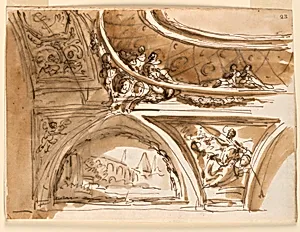
Design for Ceiling Decoration, a Barrel Vault
1790–1800
Classification
interiors
Department
Smithsonian Collection
Museum
Smithsonian American Art Museum
Credit
Museum purchase through gift of various donors and from Eleanor G. Hewitt Fund
Accession Number
1938-88-1563
Rights
Public Domain
About this artwork
Research in Progress
Art Historical Context
Giuseppe Barberi, a Italian architect and designer (1746–1809), created this *Design for Ceiling Decoration a Barrel Vault* between 1790 and 1800. Working in the late Enlightenment era, Barberi specialized in elegant interiors that blended classical antiquity with contemporary refinement, reflecting Italy's Neoclassical revival. This preparatory drawing captures his vision for a barrel vault—a sweeping, tunnel-like architectural form rooted in ancient Roman engineering, often used in grand palaces and churches to evoke grandeur and continuity. The design exemplifies the period's fascination with harmonious proportions and ornate detailing, where ceilings became canvases for illusionistic decoration. Though the medium remains unidentified amid ongoing research, such works were typically rendered in ink, wash, or gouache on paper, serving as blueprints for frescoes or stucco. Barberi's approach highlights the interdisciplinary artistry of the time, merging architecture with decorative painting to transform interior spaces into immersive environments. Acquired through museum purchase with gifts from various donors and the Eleanor G. Hewitt Fund, this piece from the Smithsonian American Art Museum's collection invites us to appreciate the meticulous planning behind opulent 18th-century interiors. It reminds visitors of how architectural drawings bridged imagination and reality, influencing lavish Roman and European salons.