
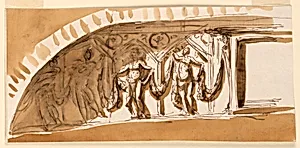
Design for Ceiling Decoration
1746-1809
Classification
interiors
Department
Smithsonian Collection
Museum
Smithsonian American Art Museum
Credit
Museum purchase through gift of various donors and from Eleanor G. Hewitt Fund
Accession Number
1938-88-1473
Rights
Public Domain
About this artwork
Research in Progress
Art Historical Context
Giuseppe Barberi (1746–1809), a prominent Italian architect and designer active in Rome during the late 18th century, created this *Design for Ceiling Decoration* amid the neoclassical revival. Trained in the vibrant artistic circles of papal Rome, Barberi specialized in elegant interior schemes, blending classical antiquity with refined ornamentation. This preparatory drawing, classified under interiors, likely served as a blueprint for opulent ceiling treatments in palatial homes or public spaces, showcasing his mastery of symmetrical motifs, stucco work, and gilded details. In the context of the Enlightenment era, Barberi's designs reflected Italy's shift from lavish Baroque excess to neoclassicism's measured grandeur, inspired by ancient Roman frescoes and Pompeian discoveries. Such ceiling plans were essential for architects commissioning grand residences, emphasizing harmony and proportion. Though the medium remains unidentified and research ongoing, its presence in the Smithsonian American Art Museum—acquired through generous donors and the Eleanor G. Hewitt Fund—highlights its enduring appeal to collectors bridging European and American tastes. This piece invites visitors to imagine the splendor of 18th-century salons, where intricate ceilings crowned conversations on art, science, and philosophy, preserving Barberi's legacy in ephemeral yet influential designs.