
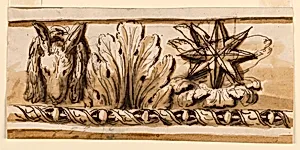
Design for ceiling decoration
1746–1809
Classification
interiors
Department
Smithsonian Collection
Museum
Smithsonian American Art Museum
Credit
Museum purchase through gift of various donors and from Eleanor G. Hewitt Fund
Accession Number
1938-88-1869
Rights
Public Domain
About this artwork
Research in Progress
Art Historical Context
Giuseppe Barberi (1746–1809), a distinguished Italian architect and designer active in, crafted this *Design for Ceiling Decoration* his prolific career bridging the late Baroque and Neoclassical periods. As a professor at the Accademia di San Luca,i specialized in elegant interior schemes that revived classical motifs—think garlands, medallions, and arabesques—for the grand palaces of the Roman elite. This preparatory drawing captures his vision for overhead ornamentation, transforming ceilings into dramatic canvases of architectural splendor. Classified under interiors in the Smithsonian Collection, the work highlights Barberi's role in the decorative arts of Enlightenment-era Italy, where such designs guided artisans in crafting stucco reliefs, frescoes, or gilding. Though the medium awaits identification amid ongoing research, it exemplifies how architects like Barberi used sketches to harmonize scale, symmetry, and symbolism in opulent spaces meant for social and cultural display. Now housed at the Smithsonian American Art Museum through a museum purchase and the Eleanor G. Hewitt Fund, this piece offers a window into 18th-century Roman luxury. As scholars continue their research, it promises deeper insights into Barberi's influence on transatlantic tastes in design.