
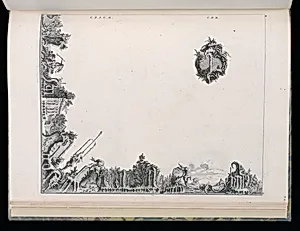
Design for Ceiling Ornament
Classification
Bound print
Department
Smithsonian Collection
Museum
Smithsonian American Art Museum
Credit
Purchased for the Museum by the Advisory Council
Accession Number
1921-6-282-73
Rights
Public Domain
About this artwork
Research in Progress
Art Historical Context
François de Cuvilliés the (1695–1768), a Belgian-born architect and designer who thrived in Germany, was a master of the exuberant Rococo style. Active in the courts of Bavaria, he created intricate designs for palaces and interiors, blending French elegance with playful asymmetry. This *Design for Ceiling Ornament an 18th-century bound print the Smithsonian American Art Museum collection, exemplifies his talent for lavish decorative schemes. As a bound print—likely from a pattern book intended for architects and craftsmen—the artwork served a practical purpose in disseminating sophisticated ornamentation across Europe. Rococo ceilings, like this one, featured scrolling motifs, shells, and floral flourishes that evoked lightness and movement, transforming rigid palace rooms into whimsical spaces. Cuvilliés's designs adorned landmarks such as Munich's Residenz, influencing the opulent interiors of the era. Though research on this specific piece is ongoing, it highlights the era's fusion of art and architecture, where printed designs democratized high-style decoration for the elite. Visitors can appreciate how such works bridged artistry and functionality, shaping the visual splendor of 18th-century Europe.