
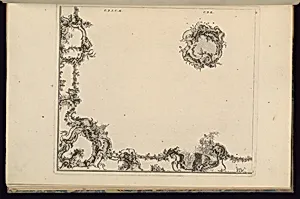
Design for Ceiling Ornament
Medium
interiors
Classification
interiors
Department
Smithsonian Collection
Museum
Smithsonian American Art Museum
Credit
Purchased for the Museum by the Advisory Council
Accession Number
1921-6-285-92
Rights
Public Domain
About this artwork
Research in Progress
Art Historical Context
**Design for Ceiling Ornament***François de Cuvilli the Elder (Belgian, active in Germany, 16951768), 1745* François de Cuvilli the Elder, a Belgian-born architect and designer who made his mark in the courts of Bavaria, created this *Design for Ceiling Ornament in 1745. primarily in Germany, he rose from humble origins—discovered as a dwarf in Brussels—to become a leading figure in European decorative arts. This piece, housed in the Smithsonian American Art's collection of interiors (purchased by the Advisory Council), reflects the opulent world of mid-18th-century princely residences, where elaborate ceiling designs transformed interiors into dazzling spectacles. As a preparatory design in the realm of architectural interiors, it showcases Cuvilliés's expertise in the Rococo style, known for its playful curves, intricate motifs like scrolls and shells, and light, airy elegance. Rococo emerged as a more intimate evolution of Baroque grandeur, favoring asymmetry and delicate ornamentation to adorn palaces such as Munich's Residenz, where Cuvilliés left his indelible stamp. Though research on this specific work is ongoing, it exemplifies how such designs guided artisans in crafting gilded stucco or frescoed vaults, blending engineering precision with artistic fantasy. This artifact invites us to imagine the flickering candlelight dancing across envisioned ceilings, a testament to the era's lavish patronage and Cuvilliés's innovative fusion of function and beauty in Europe's Age of Enlightenment. (198 words)