
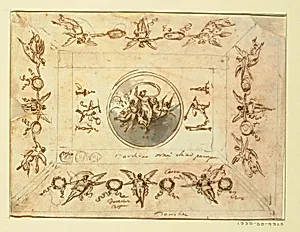
Design for Ceiling with Aurora as the Central Motif
ca. 1820
Medium
architecture, interiors
Classification
architecture, interiors
Department
Smithsonian Collection
Museum
Smithsonian American Art Museum
Credit
Museum purchase through gift of various donors and from Eleanor G. Hewitt Fund
Accession Number
1938-88-4923
Rights
Public Domain
About this artwork
Research in Progress
Art Historical Context
Felice Giani (1758–1823), a prominent Italian artist of the Neoclassical era, created this *Design for Ceiling with Aurora as the Central Motif* around 1820. Working in the late stages of his career, Giani specialized in grand decorative schemes for architecture and interiors, drawing inspiration from classical antiquity. This preparatory drawing exemplifies his skill in envisioning opulent ceiling decorations, likely intended for a palatial room or villa, where intricate designs transformed everyday spaces into mythical realms. At the heart of the composition is Aurora, the Roman goddess of dawn, symbolizing renewal, light, and the triumph of day over night. Such mythological motifs were hallmarks of Neoclassical interiors, blending ancient Roman frescoes—rediscovered through Pompeian excavations—with 19th-century elegance. Giani's fluid lines and balanced composition would guide frescoes or stucco work, creating illusions of depth and movement overhead, a technique that immersed viewers in a celestial narrative. Acquired through museum purchase and the Eleanor G. Hewitt Fund, this piece from the Smithsonian American Art Museum's architecture and interiors collection highlights the enduring influence of European design traditions. Though research continues, it invites us to ponder the splendor of Regency-era grandeur, where art elevated architecture to poetic heights.