
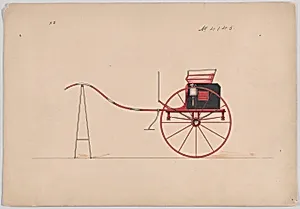
Design for Dog Cart or 2 Wheeler, no. 4145
Medium
Pen and black ink, watercolor and gouache
Dimensions
sheet: 6 5/16 x 9 1/2 in. (16 x 24.1 cm)
Classification
Drawings
Department
Drawings and Prints
Museum
Metropolitan Museum of Art, New York, NY
Credit
Gift of William Brewster, 1923
Accession Number
23.112.634
Rights
Public Domain
Tags
Art Historical Context
In the late 19th century, as America's Gilded Age flourished, luxury carriage makers like Brewster & Co. of New York crafted exquisite horse-drawn vehicles for the elite. This 1891 design drawing for a "Dog Cart or 2 Wheeler, no. 4145," attributed to the firm and draftsman Herman Stahmer, exemplifies their meticulous approach. Brewster & Co., founded in 1810, was renowned for bespoke carriages that blended functionality with elegance, serving clients like the Vanderbilts and Astors. A dog cart, typically a light two-wheeled vehicle for sport or leisure—often pulled by ponies or used for hunting dogs—represented affordable yet stylish transport amid the shift toward automobiles. Rendered in pen and black ink with watercolor and gouache on a modest 6 5/16 x 9 1/2-inch sheet, the work showcases precise linework for structural details alongside vibrant color washes to highlight upholstery, wheels, and finishes. This mixed-media technique was standard for presentation drawings, allowing makers to visualize and sell custom designs to discerning buyers. Donated to the Metropolitan Museum of Art in 1923 by William Brewster, it offers a glimpse into an era when craftsmanship defined mobility, preserving the artistry of a vanishing world of equine elegance.
About the Artist
Brewster & Co.|Herman Stahmer · 1837–present
**Brewster & Co.** Brewster & Company, a premier American coachbuilder renowned for its exquisite carriage designs, was established in 1810 in New Haven, Connecticut, by James Brewster (1788–1866). Born in 1788, Brewster trained as a wagonmaker's apprentice starting at age 16 in Northampton, Massachusetts, before relocating to New Haven, where he set up his workshop and quickly gained acclaim for...