
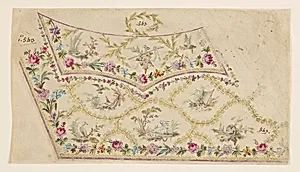
Design for Embroidery, Gentleman's Waistcoat Pocket
Classification
embroidery & stitching
Department
Smithsonian Collection
Museum
Smithsonian American Art Museum
Credit
Gift of Eleanor and Sarah Hewitt
Accession Number
1920-36-60
Rights
Public Domain
About this artwork
Research in Progress
Art Historical Context
This delicate *Design for Embroidery, Gentleman's Waistcoat Pocket* hails from the Fabrique de Saint Ruf, a renowned silk manufactory in Lyon, France, around 1785. Lyon was Europe's silk capital in the 18th century, where workshops like Saint Ruf produced exquisite textiles for the elite. This piece served as a pattern for embroidering a gentleman's waistcoat pocket—a key element of fashionable menswear during the Rococo and early Neoclassical periods, when ornate details signaled wealth and refinement. As a design in the embroidery and stitching tradition, it exemplifies the meticulous craftsmanship of Lyon's textile artists. Waistcoats, often made from silk or velvet, featured intricate floral or geometric motifs stitched with silk threads, gold, or silver, transforming functional garments into wearable art. Such designs were sampled for approval by tailors and aristocrats, highlighting the fusion of artistry and commerce in pre-Revolutionary France. Now in the Smithsonian American Art Museum's collection, gifted by collectors Eleanor and Sarah Hewitt, this artifact offers a glimpse into 18th-century luxury fashion. Though research continues, it underscores Lyon's pivotal role in global textile innovation, bridging European elegance with enduring American appreciation for fine design.