
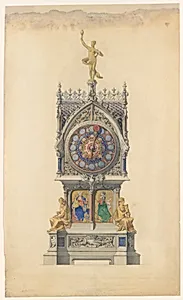
Design for Enameled Clock
ca. 1882
Medium
Pen, ink, and watercolor
Dimensions
23 x 13 3/4in. (58.4 x 34.9cm)
Classification
Drawings
Department
Drawings and Prints
Museum
Metropolitan Museum of Art, New York, NY
Credit
The Elisha Whittelsey Collection, The Elisha Whittelsey Fund, 1991
Accession Number
1991.1254
Rights
Public Domain
Tags
Art Historical Context
This preparatory drawing by Lucien Falize captures a vibrant design for an enameled clock, likely intended as a luxurious decorative object. Created around 1882 in pen, ink, and watercolor, the work showcases figures of men and women integrated with clock elements, reflecting the artist’s expertise in blending narrative scenes with functional timepieces. At 23 by 13¾ inches, the sheet’s scale suggests it served as a detailed presentation piece for clients or craftsmen. Falize, a leading French jeweler of the late nineteenth century, was renowned for his mastery of cloisonné and champlevé enameling techniques. This drawing exemplifies how such designs bridged the worlds of fine art and applied arts during the Belle Époque, when ornate household objects became statements of cultural refinement. The fluid watercolor washes and precise ink lines allowed Falize to convey the luminous effects of enamel before the piece was fabricated in metal and glass. Housed in the Metropolitan Museum of Art’s Department of Drawings and Prints, the work highlights the vital role of preparatory studies in nineteenth-century decorative arts. It offers visitors a glimpse into the creative process behind objects that once adorned fashionable interiors, celebrating both technical skill and storytelling through design.