
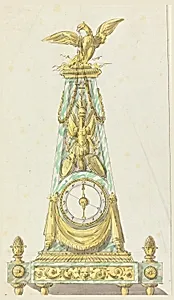
Design for a Mantel Clock
Classification
timepieces & measuring devices
Department
Smithsonian Collection
Museum
Smithsonian American Art Museum
Credit
Purchased for the Museum by the Advisory Council
Accession Number
1911-28-451
Rights
Public Domain
About this artwork
Research in Progress
Art Historical Context
This design for a mantel clock, created by French artist Jean-Louis Prieur the Younger between 1780 and 1790, captures the refined elegance of late eighteenth-century decorative arts. Prieur, who worked during the final years of the French monarchy and the early Revolutionary period, contributed to a flourishing tradition of ornamental design that blended functionality with sculptural beauty. Mantel clocks of this era served not merely as timekeepers but as centerpieces for salons and studies, often incorporating classical motifs drawn from antiquity to reflect Enlightenment ideals of order, reason, and harmony. Although the exact medium remains unknown, such preparatory designs typically guided skilled craftsmen in producing luxurious objects for aristocratic or wealthy patrons. Prieur’s work highlights the close collaboration between artists and artisans in pre-industrial France, where drawings like this one helped translate artistic vision into finely crafted metal, marble, or gilt-bronze timepieces. Now part of the Smithsonian American Art Museum’s collection, the piece offers visitors a glimpse into the sophisticated material culture that shaped daily life on the eve of the French Revolution.