
Design for Fireplace in French Renaissance Revival Style
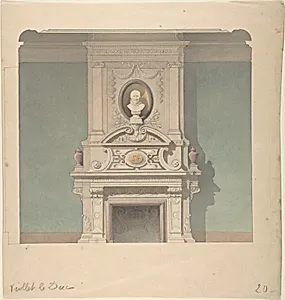
Medium
Graphite, pen and black ink, brush and gray wash, watercolor
Dimensions
12 15/16 x 12 1/8 in. (32.9 x 30.8 cm)
Classification
Drawings|Ornament & Architecture
Department
Drawings and Prints
Museum
Metropolitan Museum of Art, New York, NY
Credit
The Elisha Whittelsey Collection, The Elisha Whittelsey Fund, 1949
Accession Number
49.50.161
Rights
Public Domain
Tags
About this artwork
[Research in progress for Design for Fireplace in French Renaissance Revival Style by Anonymous, French, 19th century, 1856]
Art Historical Context
This delicate 1856 drawing offers a window into the 19th-century fascination with reviving France’s Renaissance past. Created by an anonymous French artist, the design presents an ornate fireplace that blends architectural grandeur with intricate decorative details. Such revival styles were popular during the period, reflecting a broader cultural interest in historical ornament as a way to bring elegance and prestige into modern interiors. The work’s mixed media—graphite, pen and ink, gray wash, and watercolor—highlights the careful planning behind architectural ornament. These layered techniques allowed the artist to convey both precise structural lines and the soft play of light across carved surfaces, leaves, and figurative elements. Visible portraits and foliage suggest a narrative richness typical of Renaissance-inspired designs, where human figures and natural motifs symbolized harmony between art and nature. Housed in the Metropolitan Museum’s Department of Drawings and Prints, this piece from the Elisha Whittelsey Collection serves as both a functional blueprint and a work of art in its own right, preserving the creative process behind 19th-century decorative revival.
About the Artist
Anonymous, French, 19th century · 1800–1900
**Anonymous, French, 19th Century (ca. 1800–1900)** The artist cataloged as Anonymous, French, 19th century embodies the enigmatic yet essential contributions of unidentified creators to France's vibrant 19th-century art world. Active roughly between 1800 and 1900, this figure—or potentially collective workshop—produced a diverse array of works amid the nation's transition from Neoclassicism thro...