
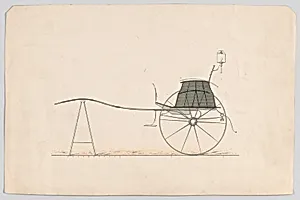
Design for Gig
Medium
Lithograph with gum arabic
Dimensions
sheet: 5 3/4 x 8 3/4 in. (14.6 x 22.2 cm)
Classification
Prints
Department
Drawings and Prints
Museum
Metropolitan Museum of Art, New York, NY
Credit
Gift of William Brewster, 1923
Accession Number
23.112.1366
Rights
Public Domain
Tags
Art Historical Context
"Design for Gig," an anonymous French lithograph from 187, captures the refined world of 19th-centuryquestrian transport. This delicate print depicts a sleek, two-wheeled gig—a lightweight carriage favored by the fashionable elite for its speed and style. Produced during a pivotal era in France, just before the Franco-Prussian War disrupted daily life, it reflects the era's obsession with mobility and design innovation in horse-drawn vehicles. Crafted as a lithograph enhanced with gum arabic, work showcases a key 19th-century printing technique. Lithography, invented decades earlier, allowed for precise, reproducible designs ideal for commercial purposes like carriage blueprints or advertisements. The gum arabic adds a subtle gloss and water resistance, heightening the image's clarity and vibrancy on its modest 5 3/4 x 8 3/4-inch sheet. Today, housed in the Metropolitan Museum of Art's Drawings and Prints department (gift of William Brewster, 1923), this unassuming gem offers a glimpse into everyday artistry. It reminds us how prints democratized design, bridging fine art and functional objects in belle époque France. Visitors will appreciate its historical charm and technical finesse!
About the Artist
Anonymous, French, 19th century · 1800–1900
**Anonymous, French, 19th Century (ca. 1800–1900)** The artist cataloged as Anonymous, French, 19th century embodies the enigmatic yet essential contributions of unidentified creators to France's vibrant 19th-century art world. Active roughly between 1800 and 1900, this figure—or potentially collective workshop—produced a diverse array of works amid the nation's transition from Neoclassicism thro...