
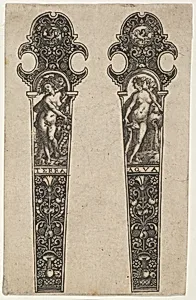
Design for Knife Handles with Terra and Aqua
1580–1600
Medium
Engraving and blackwork
Dimensions
Sheet: 3 5/8 × 2 5/16 in. (9.2 × 5.9 cm)
Classification
Prints|Ornament & Architecture
Department
Drawings and Prints
Museum
Metropolitan Museum of Art, New York, NY
Credit
Gift of Lucien Goldschmidt, 1977
Accession Number
1977.558.3
Rights
Public Domain
Tags
Art Historical Context
In the late 16th century, Theodor de Bry, a engraver from the prolific de Bry family of Antwerp and Frankfurt, created this intricate *Design for Knife Handles with and Aqua* around 1580–1600. The small engraving (just 3 5/8 × 2 5/16 inches) depicts ornate hilts inspired by classical motifs: the goddess Terra, symbolizing earth with her cornucopia of abundance, and Aqua,oking water through flowing jugs and vessels. These designs reflect the Renaissance fascination with mythological personifications, blending antiquity with contemporary craftsmanship. Rendered in engraving and blackwork—a technique using fine lines and dense cross-hatching for rich tonal depth—de Bry's print served as a model for goldsmiths and silversmiths. Such ornamental patterns were essential in the era's luxury goods trade, elevating everyday objects like knives into status symbols. Housed in the Metropolitan Museum of Art's Drawings and Prints department (gift of Lucien Goldschmidt, 1977), it exemplifies Northern European Mannerism's precision and elegance in architectural and decorative arts. This modest sheet offers a window into the collaborative world of Renaissance designers, where prints democratized elite motifs, influencing metalwork across Europe and preserving ephemeral ideas for posterity.
About the Artist
Johann Theodor de Bry · 1561–1923
Comment on works: copper engraver