
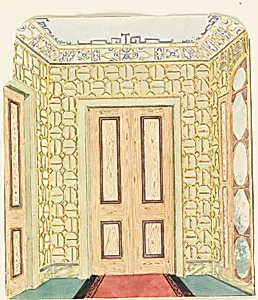
Design for Lobby, Possibly the Ante Room to the Music Room
Medium
interiors
Classification
interiors
Department
Smithsonian Collection
Museum
Smithsonian American Art Museum
Credit
Museum purchase through gift of Mrs. John Innes Kane
Accession Number
1948-40-55
Rights
Public Domain
About this artwork
Research in Progress
Art Historical Context
Frederick Crace (1779–1859), a prominent English interior designer from a family renowned for their decorative work, created this *Design for Lobby, Possibly Ante Room to the Music* between 1815 and 1822. During the Regency era, when elegant neoclassical influences dominated British interiors, Crace's designs often blended symmetry, refined ornamentation, functional beauty—hallmarks his contributions to grand homes public spaces. This piece, classified as an interior design study, likely served as a blueprint for opulent domestic spaces, highlighting the era's emphasis on harmonious room leading to specialized areas like rooms. The artwork exemplifies early 19th-century interior architecture, where lobbies or ante rooms acted as transitional spaces, setting a tone of sophistication before entering leisure areas. Crace's meticulous approach would have incorporated motifs like plasterwork, gilding, or subtle color schemes, reflecting the period's shift toward comfort amid industrial prosperity. Though research is ongoing, its presence in the Smithsonian American Art Museum's collection—acquired through the generous gift of Mrs. John Innes Kane—underscores its value in preserving transatlantic design heritage. Visitors will appreciate how this design captures the artistry of everyday luxury, inviting us to imagine the footsteps echoing through these envisioned halls. (198 words)