
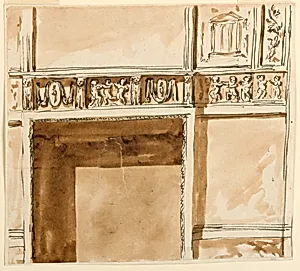
Design for Mantelpiece Reliefs, Noble Cabinet, Palazzo Altieri
Classification
interiors
Department
Smithsonian Collection
Museum
Smithsonian American Art Museum
Credit
Museum purchase through gift of various donors and from Eleanor G. Hewitt Fund
Accession Number
1938-88-1683
Rights
Public Domain
About this artwork
Research in Progress
Art Historical Context
Giuseppe Barberi, a Italian architect and designer (1746–1809), created this *Design for Mantelpiece Relief, Noble Cabinet, Palazzo Altieri* around 1789. Working in Rome during the height of Neoclassicism, Barber specialized in elegant interior decorations that revived ancient Roman motifs with refined symmetry and classical proportions. The Palazzo Altieri a grand residence of one of Rome's papal noble families, provided a fitting canvas for such opulent designs, where mantelpieces served as focal points for sculptural embellishments in lavish salons. This preparatory drawing outlines relief carvings for the Noble Cabinet—a private, dignified chamber—showcasing Barberi's mastery of ornamental architecture. Neoclassical interiors like this emphasized purity of form, mythological or allegorical motifs, and intricate detailing to evoke antiquity while suiting aristocratic tastes. Though the medium remains unidentified amid ongoing research, such designs were typically rendered in pen, ink, and wash to guide artisans in stucco or marble work. Acquired by the Smithsonian American Art Museum through donor gifts and the Eleanor G. Hewitt Fund, this piece offers a glimpse into 18th-century Roman luxury and the collaborative artistry behind Europe's noble homes. It highlights how architects like Barberi bridged drawing and execution, transforming palaces into living museums of classical revival.