
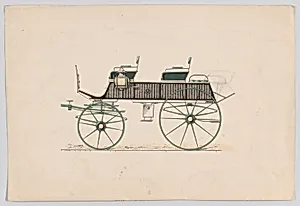
Design for Phaeton or Hunting Wagon
ca. 1870
Medium
Hand colored lithograph with gum arabic
Dimensions
sheet: 6 1/8 x 8 7/8 in. (15.6 x 22.5 cm)
Classification
Prints
Department
Drawings and Prints
Museum
Metropolitan Museum of Art, New York, NY
Credit
Gift of William Brewster, 1923
Accession Number
23.112.1367
Rights
Public Domain
Tags
Art Historical Context
This charming hand-colored lith, created anonymously by a artist around 1870 depicts a elegant design for phaeton or hunting wagon lightweight, open carriage favored the 19th-century elite for leisurely drives and equestrian pursuits. Titled *Design for Phaeton Hunting Wagon*, it captures opulent world of aristocratic transportation during France's Second Empire, when such vehicles symbolized status, speed, and sporting elegance. Phaetons, named after the mythical charioteer Phaëton, were prized for their agility, while hunting wagons accommodated gear for rural hunts, blending functionality with refined aesthetics. The medium—a lithograph enhanced with hand-applied colors and gum arabic—highlights innovative 19th-century printing techniques. Lithography allowed precise reproduction of intricate details like ornate wheels, polished wood panels, and harnesses, while hand-coloring brought vivid life to the scene. Gum arabic, a natural resin, added a glossy sheen to the hues, mimicking the luster of real lacquered carriages. Measuring just 6 1/8 x 8 7/8 inches, this intimate sheet likely served as a pattern for coachbuilders, reflecting the era's booming trade in custom vehicles before automobiles reshaped mobility. Today, housed in the Metropolitan Museum of Art's Drawings and Prints department (gift of William Brewster, 1923), it offers a window into vanishing equestrian culture, evoking the clip-clop of horses on Parisian boulevards and the thrill of the hunt. A delightful glimpse of bygone luxury!
About the Artist
Anonymous, French, 19th century · 1800–1900
**Anonymous, French, 19th Century (ca. 1800–1900)** The artist cataloged as Anonymous, French, 19th century embodies the enigmatic yet essential contributions of unidentified creators to France's vibrant 19th-century art world. Active roughly between 1800 and 1900, this figure—or potentially collective workshop—produced a diverse array of works amid the nation's transition from Neoclassicism thro...