
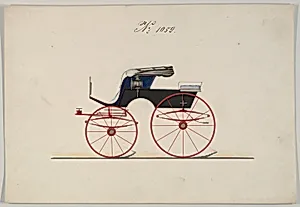
Design for Stanhope Phaeton, no. 1059
1850–74
Medium
Pen and black in, watercolor and gouache with gum Arabic and metallic ink
Dimensions
sheet: 6 1/4 x 9 3/16 in. (15.9 x 23.3 cm)
Classification
Drawings
Department
Drawings and Prints
Museum
Metropolitan Museum of Art, New York, NY
Credit
Gift of William Brewster, 1923
Accession Number
23.112.1793
Rights
Public Domain
Tags
Art Historical Context
Step into the elegant world of 19th coachmaking with *Design for Stanhopeaeton, no. 1059* by the renowned New York firm Brewster & Co. Created between 1850 and 1874, this precise drawing showcases a light, open four-wheeled carriage favored by the elite for its speed and style. Named after the inventive Earl of Stanhope the phaeton embodied luxury and leisure, a status symbol before automobiles reshaped travel. Brewster & Co., masters bespoke vehicles for America's wealthy, produced these catalogs to woo discerning clients. This sheet, now in the Metropolitan Museum of Art's Drawings and Prints collection (gift of William Brewster, 1923), captures the firm's meticulous design process. Rendered in pen and black ink for sharp lines, with watercolor, gouache, gum arabic for glossy depth, and metallic ink for shimmering highlights, it evokes the polished wood, brass fittings, and leather upholstery of the final coach—blending technical draftsmanship with artistic flair. Such designs highlight a golden age of craftsmanship, preserving the artistry of horse-drawn elegance amid industrialization. At just 6¼ x 9⅛ inches, it's a window into a vanished era of refined mobility.
About the Artist
Brewster & Co. · 1837–present
**Brewster & Co.** Brewster & Company, a premier American coachbuilder renowned for its exquisite carriage designs, was established in 1810 in New Haven, Connecticut, by James Brewster (1788–1866). Born in 1788, Brewster trained as a wagonmaker's apprentice starting at age 16 in Northampton, Massachusetts, before relocating to New Haven, where he set up his workshop and quickly gained acclaim for...