
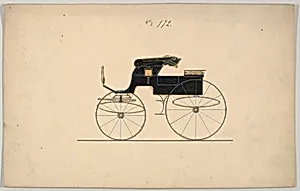
Design for Stanhope Phaeton, no. 172
1850–74
Medium
Pen and black ink, watercolor and gouache with gum Arabic
Dimensions
sheet: 6 x 9 5/8 in. (15.2 x 24.4 cm)
Classification
Drawings
Department
Drawings and Prints
Museum
Metropolitan Museum of Art, New York, NY
Credit
Gift of William Brewster, 1923
Accession Number
23.112.1719
Rights
Public Domain
Tags
Art Historical Context
Step into the elegant world of 19th-century transportation with *Design for Stanhope Phaeton, no. 172* by Brewster & Co., a premier New York carriage manufacturer. Created between 1850 and 1874, this delicate drawing captures the blueprint for a Stanhope Phaeton—a lightweight, open four-wheeled carriage favored by the elite for its speed, agility, and stylish simplicity. Named after British statesman Earl Stanhope, these vehicles were status symbols during the horse-drawn era, blending functionality with refined aesthetics before automobiles reshaped travel. Brewster & Co., renowned for crafting luxury carriages for America's wealthiest families, exemplifies the era's masterful coachbuilding. This design, gifted to the Metropolitan Museum of Art in 1923 by William Brewster, highlights their precision in envisioning vehicles that conveyed both practicality and prestige. Housed in the Drawings and Prints department, it reflects the Gilded Age's obsession with opulent mobility. Rendered on a modest 6 x 9 5/8-inch sheet, the artwork employs pen and black ink for crisp lines, layered with watercolor, gouache, and gum arabic for luminous highlights and realistic textures. This mixed-media technique not only showcases technical virtuosity but also preserves the artistry behind everyday luxury, offering a glimpse into a vanishing craft.
About the Artist
Brewster & Co. · 1837–present
**Brewster & Co.** Brewster & Company, a premier American coachbuilder renowned for its exquisite carriage designs, was established in 1810 in New Haven, Connecticut, by James Brewster (1788–1866). Born in 1788, Brewster trained as a wagonmaker's apprentice starting at age 16 in Northampton, Massachusetts, before relocating to New Haven, where he set up his workshop and quickly gained acclaim for...