
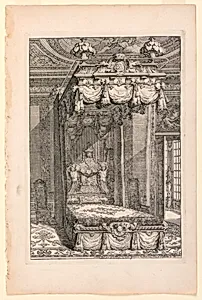
Design for State Bedchamber, in Second Livre d'Appartement (Second Book on Interiors)
Classification
architecture
Department
Smithsonian Collection
Museum
Smithsonian American Art Museum
Credit
Museum purchase from General Acquisitions Endowment Fund
Accession Number
1988-4-56
Rights
Public Domain
About this artwork
Research in Progress
Art Historical Context
Daniel Marot (1661–1752), a French Huguenot architect and engr who found patronage in the Netherlands and England created this *Design for State Bedchamber around 1700 as part of his *Second Livre d'App* (Second Book oniors). Fleeing religious persecution in France, Mar brought the grandeur of Louis XIV's Versailles to northern European courts, working for figures like William III of Orange. His designs, often disseminated through printed books, popularized ornate Baroque interiors among the elite. This architectural rendering exemplifies Marot's signature style: symmetrical compositions filled with lavish details like canopied beds, tapestried walls, gilded moldings, and sculptural furnishings. As a printed design plate, it served as a blueprint for nobility to replicate opulent state bedchambers—spaces for receiving guests and displaying power. Though the medium is unknown, such works were typically etched or engraved, making high-style decoration accessible to architects and craftsmen across Europe. Housed in the Smithsonian American Art Museum, this piece highlights the transatlantic flow of European design influences that later shaped American interiors. Its presence underscores Marot's enduring legacy in bridging French elegance with Anglo-Dutch tastes during a golden age of interior architecture. (198 words)