
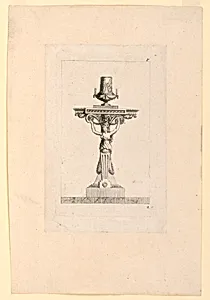
Design for Table, Plate 2 from "Six Tables Grecques & Pendules"
Medium
Classification
Department
Smithsonian Collection
Museum
Smithsonian American Art Museum
Credit
Purchased for the Museum by the Advisory Council
Accession Number
1921-6-75-2
Rights
Public Domain
About this artwork
Research in Progress
Art Historical Context
This elegant print, created around 1780 by French designer Juste-François Boucher, offers a window into the refined world of late eighteenth-century decorative arts. As Plate 2 from the series “Six Tables Grecques &ules,” it presents a detailed design for a neoclassical table inspired by ancient Greek forms. Boucher, son of the celebrated rococo painter François Boucher, specialized in furniture and ornament designs that helped shape the emerging taste for classical simplicity and symmetry during the final decades of the French monarchy. Printed works like this one played a vital role in disseminating new styles across Europe. Cabinetmakers, patrons, and fellow artists could study and adapt these engravings, allowing innovative designs to reach workshops far beyond Paris. Created just before the French Revolution, the series reflects the period’s fascination with archaeology and the ideals of ancient Greece and Rome, marking a clear shift from the ornate curves of rococo toward the clean lines and balanced proportions of neoclassicism. Today, this print resides in the Smithsonian American Art Museum, acquired through the Advisory Council. Though research on the series continues, it remains a valuable document of how printed pattern books influenced the material culture of the Enlightenment era.