
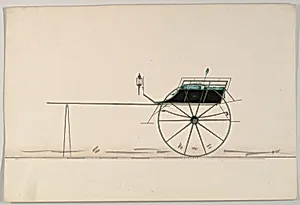
Design for Tandem/Village Cart (unnumbered)
Medium
Pen and black ink, watercolor and gouache with gum arabic
Dimensions
sheet: 5 7/8 x 8 7/8 in. (14.9 x 22.5 cm)
Classification
Drawings
Department
Drawings and Prints
Museum
Metropolitan Museum of Art, New York, NY
Credit
Gift of William Brewster, 1923
Accession Number
23.112.1917
Rights
Public Domain
Tags
Art Historical Context
This delicate design drawing captures a tandem or village cart, a light, two-wheeled vehicle popular in the mid-nineteenth century for leisurely country drives. Created between 1850 and 1874 by the renowned New York firm Brewster & Co. in collaboration with designer Channing Britton, the sheet served as a working proposal for clients, illustrating the graceful lines and practical details of a carriage meant for tandem driving—one horse behind the other. Executed in pen and black ink with watercolor and gouache heightened by gum arabic, the medium allowed the artists to convey both precise engineering measurements and the rich textures of wood, metal, and upholstery. The luminous quality of the gouache and the glossy finish provided by gum arabic give the small sheet (just under 6 by 9 inches) a jewel-like presence, transforming a utilitarian design into an object of visual appeal. As part of the Metropolitan Museum’s collection of drawings and prints, this work offers a rare glimpse into the collaborative world of American carriage making, where industrial craftsmanship met refined aesthetic taste during an era when such vehicles symbolized both mobility and social status.
About the Artist
Brewster & Co.|Channing Britton · 1837–present
**Brewster & Co.** Brewster & Company, a premier American coachbuilder renowned for its exquisite carriage designs, was established in 1810 in New Haven, Connecticut, by James Brewster (1788–1866). Born in 1788, Brewster trained as a wagonmaker's apprentice starting at age 16 in Northampton, Massachusetts, before relocating to New Haven, where he set up his workshop and quickly gained acclaim for...