
Design for the "Cahier de Balençoires Chinoises"
1770
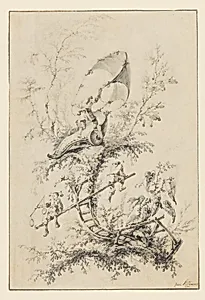
Medium
Black chalk, with stumping, framing lines in pen and brown ink
Dimensions
Sheet: 11 7/8 × 8 1/8 in. (30.2 × 20.6 cm)
Classification
Drawings|Ornament & Architecture
Department
Drawings and Prints
Museum
Metropolitan Museum of Art, New York, NY
Credit
Frits and Rita Markus Fund, 2023
Accession Number
2023.208
Rights
Public Domain
Art Historical Context
Jean Pillement's *Design for the "Cier de Balençoiresinoises"* (1770) captures the whimsical spirit of 18th-century chinoiserie, a European fascination with imagined Chinese motifs. Created during the late Rococo era, when ornate, playful designs adorned palaces and furnishings across France and beyond, this drawing likely served as a preparatory study for a notebook (*cahier*) of ornamental patterns swings—elegant, fantastical scenes blending exotic fantasy with decorative elegance. Pillement, a master of Rococo ornamentation, drew inspiration from Asian imports and travelogues, infusing his works with lush foliage, pagodas, and graceful figures to appeal to aristocratic tastes. Executed in black chalk with stumping—a technique that softens tones for smoky, atmospheric effects—and accented by precise framing lines in pen and brown ink, the modest sheet (11 7/8 × 8 1/8 in.) exemplifies Pillement's skill in fluid, intricate linework. Such drawings were vital for printmakers and decorators, translating into wallpapers, textiles, and furniture. Housed in the Metropolitan Museum of Art's Drawings and Prints department, this 2023 acquisition highlights the enduring allure of Rococo's lighthearted escapism amid Europe's shifting artistic tides toward Neoclassicism. A delightful glimpse into a bygone era of opulent reverie!
About the Artist
Jean Pillement · 1728–1808
**Jean-Baptiste Pillement (also known as Jean Pillement)** was a French painter, designer, and engraver born on 24 May 1728 in Lyon, where he also died on 26 April 1808. He became one of the most influential decorative artists of the Rococo period, celebrated for his delicate landscapes and exotic chinoiserie designs that spread across Europe through prints and decorative applications. Pillement ...