
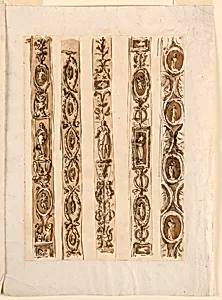
Design for the Decorations of Five Pilaster Strips
Medium
interiors
Classification
interiors
Department
Smithsonian Collection
Museum
Smithsonian American Art Museum
Credit
Museum purchase through gift of various donors and from Eleanor G. Hewitt Fund
Accession Number
1938-88-1471
Rights
Public Domain
About this artwork
Research in Progress
Art Historical Context
Giuseppe Barberi (174–1809), a prominent Italian architect and designer in Rome, created this *Design for the Decorations Five Pilaster Strips around 1790.asters—flattened columnar elements projecting from walls—were essential to neoclassical interiors, evoking the grandeur of ancient Roman architecture. Barberi's drawing likely served as a blueprint for ornate wall decorations, blending symmetry, classical motifs, and refined ornamentation typical of the era's shift from Baroque exuberance to elegant restraint. This work exemplifies the late 18th-century fascination with antiquity, as architects like Barberi drew inspiration from archaeological discoveries at sites like Pompeii and Herculaneum. His designs contributed to Rome's opulent palazzos and villas, influencing European interior trends. Though classified under "interiors" in the Smithsonian American Art Museum's collection (acquired through donor gifts and the Eleanor G. Hewitt Fund), it highlights transatlantic appreciation for Italian decorative arts. Today, with research ongoing, this piece invites us to envision how intricate patterns transformed everyday spaces into timeless statements of sophistication. A testament to Barberi's skill, it bridges architecture and artistry in the neoclassical canon.