
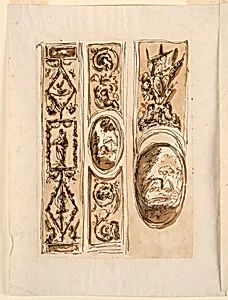
Design for the Decorations of Pilaster Strips
1789-1793
Medium
architecture
Classification
architecture
Department
Smithsonian Collection
Museum
Smithsonian American Art Museum
Credit
Museum purchase through gift of various donors and from Eleanor G. Hewitt Fund
Accession Number
1938-88-1470
Rights
Public Domain
About this artwork
Research in Progress
Art Historical Context
Giuseppe Barberi, a Italian architect (1746–1809), this *Design for the Decorations Pilaster Strips* 1789 and 1793, during the height of Neoclassicism in Europe. Pilasters—flat, columnar projections on walls—were essential in classical architecture for adding rhythm and grandeur to facades. Barberi's design exemplifies the era's revival of ancient Roman motifs, blending precise geometry with ornate detailing to elevate architectural surfaces. As an architectural drawing, this work served as a blueprint for stucco or carved embellishments, showcasing Barberi's expertise in ornamental design. He was a key figure in Rome's Accademia di San Luca, where such preparatory sketches guided builders in achieving harmonious proportions inspired by antiquity. The piece highlights how late-18th-century architects like Barberi bridged theory and practice, influencing grand public buildings across Italy. Now housed in the Smithsonian American Art Museum's architecture collection (museum purchase through various donors and the Eleanor G. Hewitt Fund), this design offers a window into the meticulous craft of neoclassical decoration. Though research continues, it reminds us of architecture's role as sculpted storytelling.