
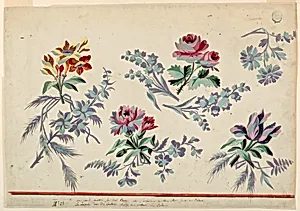
Design for the Embroidery of a Horizontal Border, Pattern No. 23 of the "Fabrique de St. Ruf"
1775-1800
Classification
Drawing
Department
Smithsonian Collection
Museum
Smithsonian American Art Museum
Credit
Gift of Eleanor and Sarah Hewitt
Accession Number
1920-36-314
Rights
Public Domain
About this artwork
Research in Progress
Art Historical Context
This delicate drawing, titled *Design for the Embroidery a Horizontal Border, Pattern. 23 of the "Fabrique de St."*, hails from the renowned Fabrique de Saint Ruf in, France, a powerhouse of textile innovation during the late 18 century (1775–1800). Lyon was Europe's silk capital, where workshops like Saint Ruf produced exquisite fabrics for elite wardrobes and interiors, blending artistry with commerce. As a preparatory drawing for embroidery, this pattern exemplifies the meticulous design process behind luxurious borders—repeating motifs destined for garments, furnishings, or trims that adorned the fashionable world of pre-Revolutionary France. Though the medium remains unidentified amid ongoing research, such designs were typically rendered in ink, watercolor, or gouache on paper, serving as blueprints for weavers and embroiderers. They highlight the era's transition from ornate Rococo flourishes to emerging Neoclassical elegance, reflecting Lyon's role in exporting opulent textiles across continents. Now part of the Smithsonian American Art Museum's collection—thanks to the generous gift of Eleanor and Sarah Hewitt—this artifact offers a window into the collaborative craft of 18th-century design, where a single pattern could spark widespread production. Visitors will appreciate how this modest drawing captures the hidden labor behind grand luxury, connecting everyday museum-goers to the vibrant textile heritage of ancien régime France.