
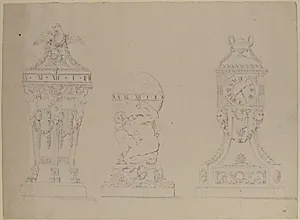
Design for Three Clocks
Late 18th century
Medium
Graphite
Dimensions
10 3/4 x 14 11/16 in. (27.3 x 37.3 cm)
Classification
Drawings
Department
Drawings and Prints
Museum
Metropolitan Museum of Art, New York, NY
Credit
Gift of Raphael Esmerian, 1960
Accession Number
60.692.9
Rights
Public Domain
Tags
Art Historical Context
This graphite drawing, created by an anonymous French artist in the late 18th century, offers a charming glimpse into the decorative arts of the period. Titled *Design for Three Clocks*, the sheet presents three distinct clock designs, each incorporating lively motifs such as men, globes, and chickens. Rendered with precise linework typical of preparatory sketches, the work likely served as a blueprint for ornate clock cases destined for wealthy households or royal interiors. In 18th-century France, clocks transcended mere timekeeping to become symbols of enlightenment ideals and technological progress. Artisans frequently blended functional mechanisms with allegorical or whimsical elements—like roosters representing vigilance or globes evoking scientific discovery—to appeal to sophisticated patrons. Graphite, valued for its erasability and fine detail, allowed designers to experiment freely before committing to costly materials such as bronze or marble. Housed in the Metropolitan Museum of Art’s Department of Drawings and Prints, this piece highlights the collaborative yet often unattributed nature of decorative design during the era. Its modest scale belies the cultural importance of such studies, which influenced the luxurious objects that defined French taste on the eve of the Revolution.
About the Artist
Anonymous, French, 18th century · 1700–1800
The artist known as Anonymous, French, 18th century, represents a collective of unidentified talents active roughly between 1700 and 1800, a period of profound artistic evolution in France from the opulent Rococo to the austere dawn of Neoclassicism and Revolutionary fervor. Little is documented about their personal training or mentors, as their anonymity obscures individual biographies, though th...