
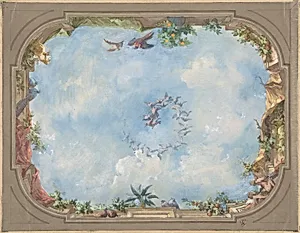
Design for Trompe l'Oeil Stairway Ceiling, Hôtel Hope
Medium
Pen and brown ink
Dimensions
5 13/16 x 7 9/16 in. (14.8 x 19.2 cm)
Classification
Drawings|Ornament & Architecture
Department
Drawings and Prints
Museum
Metropolitan Museum of Art, New York, NY
Credit
Dodge Fund, 1967
Accession Number
67.827.103
Rights
Public Domain
Tags
Art Historical Context
This exquisite pen and brown ink drawing from 7, created by Jules-Edmond-Charles Lise and Eugène-Pierredet, presents a *Design for Trompe leil Stairway Ceiling for the grand Hôtel Hope in Paris. just 5 13/ x 7 9/16 inches, this preparatory sketch captures the opulence of Second Empire France, when lavish interior decorations transformed private residences into theatrical spaces. The artists, skilled in ornament and architecture, envisioned a ceiling that would dissolve boundaries, using trompe l'oeil—the French art of visual illusion—to mimic a boundless sky filled with fluffy clouds, soaring birds, and majestic peacocks. Trompe l'oeil techniques, rooted in Renaissance traditions but revived in the 19th century, were prized for their mind-bending realism, making viewers feel as if they gazed upward into the heavens rather than at painted plaster. Here, the precise brown ink lines suggest intricate patterns of feathers and vaporous clouds, likely intended for execution in fresco or oil to enhance the Hôtel's dramatic stairway. Peacocks, symbols of immortality and beauty in French decorative arts, add a touch of exotic splendor. Housed in the Metropolitan Museum of Art's Drawings and Prints department (acquired via the Dodge Fund in 1967), this work reveals how 19th-century designers blended technical mastery with fantasy, inviting us to imagine ascending a staircase beneath an illusory firmament. A delightful glimpse into the era's architectural dreams!
About the Artist
Jules-Edmond-Charles Lachaise|Eugène-Pierre Gourdet · 1897–1897
Jules-Edmond-Charles Lachaise, born Jules Lachaise on September 2, 1836, in Paris, emerged as a prominent French painter and draughtsman specializing in lavish interior decorations during the Second Empire and beyond. Little is known about his early life and formal training, though he married Berthe Gourdet in 1866, forging a close professional partnership with her brother, the decorator Eugène-Pi...