
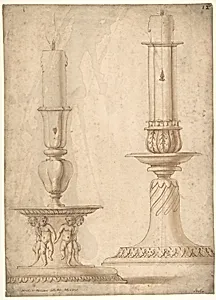
Design for Two Candlesticks with decorated Bases
early 16th century
Medium
Pen and brown ink, brush and brown wash over traces of leadpoint
Dimensions
Image: 14 1/2 x 10 1/2 in. (36.9 x 26.6 cm)
Classification
Drawings
Department
Drawings and Prints
Museum
Metropolitan Museum of Art, New York, NY
Credit
The Elisha Whittelsey Collection, The Elisha Whittelsey Fund, 1949
Accession Number
49.50.70
Rights
Public Domain
Tags
Art Historical Context
This delicate drawing by Giulio Romano captures two ornate candlestick designs, their bases enlivened with playful figures of children or putti. Created in the early sixteenth century, the sheet reflects the vibrant artistic culture of Renaissance Italy, when leading painters like Romano—once a favored pupil of Raphael—often turned their talents to decorative objects for churches, palaces, and wealthy patrons. Such designs bridged the worlds of fine art and craftsmanship, allowing sculptors and metalworkers to translate the artist’s vision into three-dimensional silver or bronze. Executed in pen and brown ink with fluid washes over faint leadpoint, the work showcases the economical yet expressive techniques favored for presentation drawings. The warm brown tones and subtle shading give volume to the twisting forms and lively figures, demonstrating how Romano could convey both architectural structure and sculptural detail on a flat sheet. Measuring roughly 14½ by 10½ inches, the drawing’s scale suggests it was meant for close study rather than public display. Today preserved in the Metropolitan Museum’s collection of Drawings and Prints, the sheet offers a rare glimpse into the collaborative process behind Renaissance luxury goods. It reminds viewers that even functional objects like candlesticks could become vehicles for artistic invention and storytelling.
About the Artist
Giulio Romano · 1499–1546
Giulio Romano (c. 1499–1546) was the most gifted pupil of Raphael and one of the founding figures of Mannerism, the style that succeeded the High Renaissance in Italy. Born Giulio Pippi in Rome, he entered Raphael's workshop as a boy and proved so talented that by the time of Raphael's death in 1520 he was effectively running the studio and overseeing the completion of major unfinished commissions...