
Design for Upright Decorative Panels
18th century
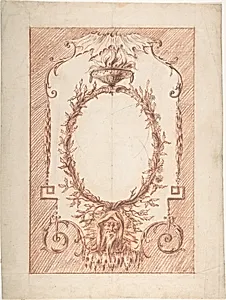
Medium
Red chalk over black chalk
Dimensions
sheet: 13 3/4 x 10 3/8 in. (35 x 26.3 cm)
Classification
Drawings
Department
Drawings and Prints
Museum
Metropolitan Museum of Art, New York, NY
Credit
Rogers Fund, 1969
Accession Number
69.552.1
Rights
Public Domain
Tags
Art Historical Context
This delicate drawing, titled *Design for Upright Decorative*, hails from an anonymous French artist of the 18th century, a time when ornate interiors graced the salons of Versailles and Parisian aristocracy. Created on a modest sheet measuring 13 /4 x 10 3/8 inches, it exemplifies the preparatory sketches vital to France's flourishing decorative arts. The design likely features elegant wreaths—symbolizing victory, celebration, and natural abundance—intended for upright panels on furniture, walls, or screens, reflecting the era's love for symmetrical, harmonious ornamentation amid the transition from lavish Rococo to refined Neoclassicism. The medium of red chalk over black chalk reveals masterful technique: the black underlayer provides bold outlines and shadows, while the red adds warmth, modeling, and subtle highlights for a lifelike depth. Such layered drawings were essential tools for artisans, allowing designers to refine motifs before execution in gilt bronze, wood, or fabric. This piece, acquired through the Rogers Fund in 1969 and housed in the Metropolitan Museum of Art's Drawings and Prints department, offers a glimpse into the collaborative craft behind France's opulent 18th-century aesthetic, where every flourish contributed to an atmosphere of refined luxury.
About the Artist
Anonymous, French, 18th century · 1700–1800
The artist known as Anonymous, French, 18th century, represents a collective of unidentified talents active roughly between 1700 and 1800, a period of profound artistic evolution in France from the opulent Rococo to the austere dawn of Neoclassicism and Revolutionary fervor. Little is documented about their personal training or mentors, as their anonymity obscures individual biographies, though th...