
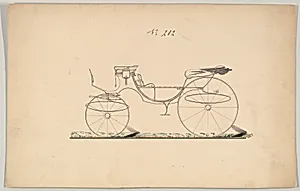
Design for Vis-à-vis, no. 202
Medium
Pen and black ink, watercolor and gouache
Dimensions
6 3/8 x 10 in. (16.2 x 25.4 cm)
Classification
Drawings
Department
Drawings and Prints
Museum
Metropolitan Museum of Art, New York, NY
Credit
Gift of William Brewster, 1923
Accession Number
23.112.1501
Rights
Public Domain
Tags
Art Historical Context
This delicate design drawing captures a proposed "vis-à-vis" carriage, a graceful vehicle in which passengers sat facing one another, fostering intimate conversation during outings. Created between 1850 and 1870 by Brewster & Co. in collaboration with designer Channing Britton, the sheet served as a working proposal for one of America’s most prestigious carriage makers. At just over six by ten inches, the compact format allowed clients to envision the vehicle’s elegant lines and proportions before it was built. Executed in pen and black ink with watercolor and gouache, the drawing highlights Brewster’s meticulous attention to both engineering and aesthetics. Subtle washes define the curves of the body, the sweep of the fenders, and the gleam of metal fittings, while crisp ink lines detail the suspension and wheel construction. Such presentation drawings bridged the worlds of fine art and industry, helping wealthy patrons select custom vehicles that reflected their status. Today preserved in the Metropolitan Museum’s Department of Drawings and Prints, this work offers a vivid glimpse into nineteenth-century urban mobility. Before automobiles, finely crafted carriages like this one shaped social rituals and street life, turning everyday travel into a statement of taste and refinement.
About the Artist
Brewster & Co.|Channing Britton · 1837–present
**Brewster & Co.** Brewster & Company, a premier American coachbuilder renowned for its exquisite carriage designs, was established in 1810 in New Haven, Connecticut, by James Brewster (1788–1866). Born in 1788, Brewster trained as a wagonmaker's apprentice starting at age 16 in Northampton, Massachusetts, before relocating to New Haven, where he set up his workshop and quickly gained acclaim for...