
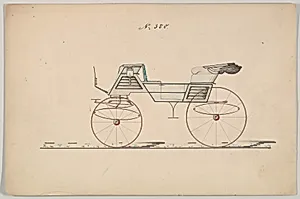
Design for Vis-à-vis, no. 380
Medium
Pen and black ink, watercolor and gouache
Dimensions
sheet: 6 1/2 x 10 in. (16.5 x 25.4 cm)
Classification
Drawings
Department
Drawings and Prints
Museum
Metropolitan Museum of Art, New York, NY
Credit
Gift of William Brewster, 1923
Accession Number
23.112.3106
Rights
Public Domain
Tags
Art Historical Context
Step into the elegant world of 19th-century coachmaking with *Design for Vis-à-vis no. 380*, a delicate rendering by Brewster & Co., with attribution to Channing Britton, 1850–70. Produced by one of America's premier carriage manufacturers, this drawing captures the refined lines of a vis-à-vis—a light, two-horse carriage featuring facing bench seats, ideal for intimate social outings among the elite. Brewster & Co., founded in New York in 1810, crafted bespoke vehicles for luminaries like Abraham Lincoln and the Vanderbilts, blending functionality with opulent style during the horse-drawn era's golden age. This design exemplifies their mastery, showcasing intricate details like curved panels and spoked wheels that promised both speed and sophistication on city streets or country roads. Donated to the Metropolitan Museum of Art in 1923 by William Brewster, it preserves a snapshot of pre-automobile luxury. Rendered in pen and black ink with watercolor and gouache on a modest 6½ × 10-inch sheet, the work highlights precise draftsmanship typical of industrial design drawings. These mixed-media techniques allowed for vivid color accents and shading, making the proposal leap off the page for discerning clients. A charming relic of Gilded Age craftsmanship, it invites us to imagine the clip-clop of hooves echoing through a vanished urban landscape.
About the Artist
Brewster & Co.|Channing Britton · 1837–present
**Brewster & Co.** Brewster & Company, a premier American coachbuilder renowned for its exquisite carriage designs, was established in 1810 in New Haven, Connecticut, by James Brewster (1788–1866). Born in 1788, Brewster trained as a wagonmaker's apprentice starting at age 16 in Northampton, Massachusetts, before relocating to New Haven, where he set up his workshop and quickly gained acclaim for...