
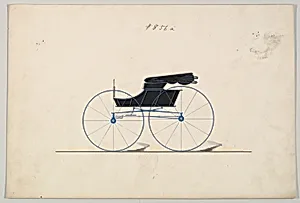
Design for Wagon, no. 856a
ca. 1860
Medium
Pen, black ink, watercolor and gouache with gum arabic
Dimensions
sheet: 6 x 9 in. (15.2 x 22.9 cm)
Classification
Drawings
Department
Drawings and Prints
Museum
Metropolitan Museum of Art, New York, NY
Credit
Gift of William Brewster, 1923
Accession Number
23.112.2023
Rights
Public Domain
Tags
Art Historical Context
Step into the opulent world of 19th-century American carriage design with *Design for Wagon, no 856a* by Brewster & Co., 1860. Created by one of New York City's premier carriage manufacturers, this delicate drawing captures proposal for a luxury wagon—model 856a—tailored for the elite. At just 6 x 9 inches, it exemplifies the meticulous planning behind horse-drawn vehicles that symbolized status before the automobile era. Brewster & Co., founded in1810, crafted bespoke carriages for presidents, royalty, and tycoons, blending functionality with artistry. This design reflects the firm's peak during the Civil War years, when ornate wagons served as both transport and social display. Donated to the Metropolitan Museum of Art in 1923 by William Brewster, it preserves a snapshot of industrial design's golden age, highlighting how carriages were engineered like rolling sculptures. Rendered in pen and black ink for precise lines, with vibrant watercolor, gouache, and glossy gum arabic, the medium mimics the polished finishes of the final product. This technique allowed designers to convey texture, color, and sheen vividly, bridging fine art and craftsmanship in a single sheet. A charming window into Gilded Age mobility!
About the Artist
Brewster & Co. · 1837–present
**Brewster & Co.** Brewster & Company, a premier American coachbuilder renowned for its exquisite carriage designs, was established in 1810 in New Haven, Connecticut, by James Brewster (1788–1866). Born in 1788, Brewster trained as a wagonmaker's apprentice starting at age 16 in Northampton, Massachusetts, before relocating to New Haven, where he set up his workshop and quickly gained acclaim for...